
Deploying custom app-chains has never been more accessible than in 2025, thanks to the evolution of Rollup-As-A-Service (RaaS) platforms. For blockchain developers, the ability to launch scalable, application-specific rollups in days, not months, is transforming how projects approach scalability and customization. Below, we break down the essential steps and best practices for deploying your own app-chain using RaaS, with a focus on reliability, performance, and security.
Why Developers Are Choosing Rollup-As-A-Service in 2025
The surge in demand for custom app-chains is driven by two core needs: dedicated blockspace and cost efficiency. RaaS platforms abstract away infrastructure headaches, sequencer management, data availability integration, and security monitoring, so teams can focus on building unique applications. Leading providers like Caldera, Conduit, Instanodes, AltLayer, and Gelato Rollups now offer robust frameworks supporting OP Stack, Arbitrum Orbit, zkEVMs, and modular data layers. This flexibility empowers projects to tailor every layer of their stack while ensuring high uptime and seamless asset bridging.
If you’re new to this landscape or want an up-to-date walkthrough on launching a custom rollup chain efficiently, this guide is for you. We’ll walk through each critical step, from repository integration to live deployment, using the latest RaaS best practices.
Step 1: Sign Up and Connect Your Repository to the RaaS Platform
Your journey starts by creating an account with your chosen RaaS provider. Most leading platforms now support direct GitHub or GitLab integration for streamlined CI/CD workflows. After sign-up:
- Connect your codebase: Link your smart contracts or app logic repository directly to the RaaS dashboard.
- Automated dependency checks: Platforms scan for compatibility issues or missing libraries before deployment begins.
This foundational step ensures that updates to your codebase can be deployed seamlessly as your chain evolves.
Step 2: Select Your Preferred Rollup Framework (e. g. , OP Stack, zkEVM, Arbitrum Orbit)
The next decision is framework selection. Each framework offers distinct benefits:
- OP Stack: Popular for EVM compatibility and robust tooling support.
- zkEVM: Chosen for privacy features and advanced scalability via zero-knowledge proofs.
- Arbitrum Orbit: Ideal for modularity and custom Layer 3 deployments.
Your choice here determines not only technical capabilities but also ecosystem integrations (wallets, bridges) available out-of-the-box. Most RaaS dashboards provide comparison charts or wizards to help you match framework features with your project’s requirements. For deeper insights into framework differences and selection strategies, see our detailed coverage at How to Launch Custom App-Chains Using Rollup-As-A-Service Platforms.
Step 3: Configure App-Chain Parameters: Consensus, Sequencer Options and Custom Features
This is where customization shines. Developers can:
- Select consensus mechanisms: Choose between proof-of-stake variants or delegated sequencers based on desired decentralization vs speed trade-offs.
- Tune sequencer options: Some platforms allow you to run your own sequencer node or opt into managed services with guaranteed uptime SLAs (Service Level Agreements).
- Add custom features: Integrate native tokens, permissioned access controls, or MEV-resistant transaction ordering as needed for your application vertical.
This flexibility ensures that whether you’re building DeFi protocols requiring rapid finality or gaming chains focused on low fees and high throughput, you can tailor parameters accordingly. For a comprehensive tutorial on parameter configuration within different frameworks, including real-world examples, check our resource at How Rollup-As-A-Service Simplifies Appchain Deployment for Blockchain Developers.
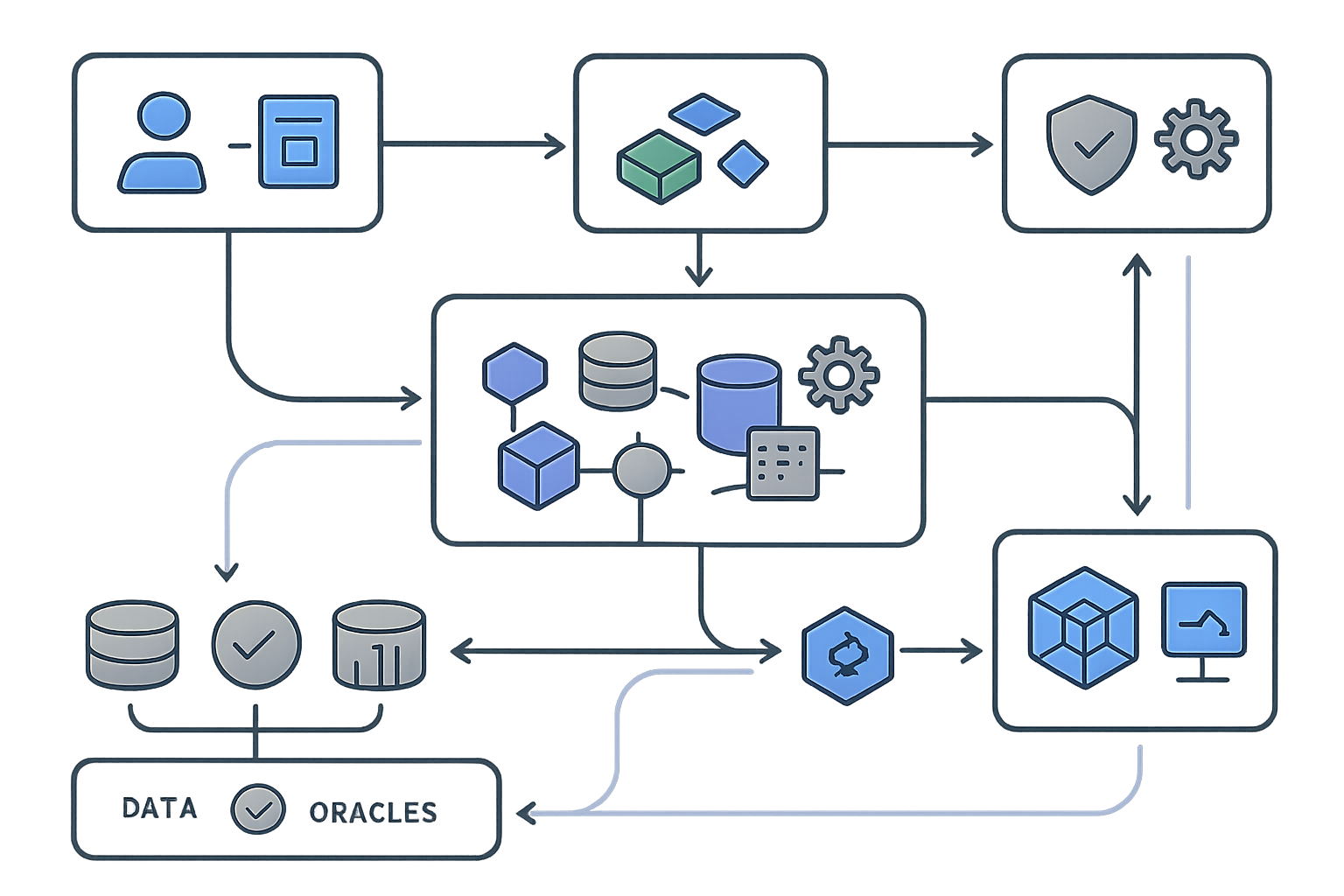
Step 4: Integrate Essential Infrastructure: Data Availability, Oracles, and Indexers
With your app-chain’s core parameters set, it’s time to plug in the infrastructure that powers real-world utility and reliability. Data availability is foundational, most RaaS providers let you choose between Ethereum mainnet, Celestia, or EigenDA for storing transaction data securely and affordably. For projects that require off-chain information (like DeFi, gaming, or prediction markets), integrating oracles is a must. Leading platforms offer pre-built connections to Chainlink, Pyth, or custom oracle endpoints.
- Indexers: Add robust indexing solutions like The Graph to enable fast querying of chain data for dApps and analytics dashboards.
- Modularity: Most RaaS platforms support plug-and-play modules for analytics, bridges, and even governance tools, so you can extend your app-chain as your user base grows.
This modular approach ensures your chain isn’t just live, it’s ready for production-grade workloads from day one. For more on integrating critical infrastructure components using abstract rollup technology, see our guide on how Rollup-As-A-Service platforms simplify app chain deployment.
Step 5: Deploy to Mainnet or Testnet with Automated Monitoring Enabled
The moment of truth: deployment. With a few clicks in your RaaS dashboard, or via CI/CD automation, you can launch to testnet for final validation or go straight to mainnet when ready. Modern RaaS services offer:
- Automated monitoring: Real-time dashboards track block production, gas usage, uptime SLAs, and cross-chain bridge health.
- Error alerts: Get instant notifications if sequencer liveness drops or abnormal activity is detected.
- Rollback options: Some platforms allow quick rollbacks in case of critical bugs during early mainnet stages.
This level of observability means you can confidently iterate on features while ensuring end-user trust from launch day onward.
Step 6: Optimize Performance and Security with Continuous Updates and Expert Support
Your app-chain’s journey doesn’t end at launch; ongoing optimization is vital as user demand grows and new threats emerge. Top-tier RaaS providers deliver continuous updates, patching vulnerabilities, optimizing node performance, and rolling out new integrations without downtime. Many also offer dedicated expert support channels for troubleshooting complex issues or customizing advanced features like MEV protection or multi-sig governance upgrades.
- Performance tuning: Leverage built-in analytics tools to identify bottlenecks in transaction throughput or latency.
- Security hardening: Schedule regular audits via integrated partners; monitor for suspicious activity with automated threat detection modules.
- Ecosystem upgrades: Seamlessly adopt new protocol standards (e. g. , EIP upgrades) as they emerge across the rollup landscape.
This proactive approach keeps your infrastructure resilient, and ensures your users always enjoy best-in-class security and speed. For more strategies on scaling securely after deployment, explore our coverage of continuous improvement practices at how Rollup-As-A-Service platforms are revolutionizing blockchain scalability for app-chains.
Key Takeaways for Blockchain Developers in 2025
The rise of Rollup-As-A-Service has dramatically lowered the barrier to launching bespoke blockchains tailored to unique application needs. By following this step-by-step process, sign up and connect your repository; select the right framework; configure consensus and sequencer options; integrate essential infra; deploy with monitoring; then optimize continuously, you can focus on innovation instead of infrastructure headaches. The result? Faster time-to-market, lower costs per transaction, and a scalable foundation ready for whatever Web3 brings next.




No comments yet. Be the first to share your thoughts!