

In the high-stakes world of decentralized trading, where every millisecond counts, ReyaChain has redefined what's possible on Ethereum. As the pioneering trading-specific based rollup, it delivers sub-millisecond execution speeds, gasless trades, and Ethereum-grade security, all while clocking $32 billion in cumulative perpetual volume as of late 2025. With Ethereum trading at $1,967.14 today, up a modest $1.78 in the last 24 hours, the stage is set for a new wave of specialized rollups. Developers and traders alike are eyeing based rollups for trading, and Rollup-As-A-Service (RaaS) from abstractwatch. com makes launching your own ReyaChain-like chain straightforward in 2026.
ReyaChain's Edge: Speed Meets Decentralization
ReyaChain stands out by forking and customizing Arbitrum Orbit, creating a lean L2 optimized for perpetual DEX trading. Its based rollup design delegates sequencing to Ethereum validators, ensuring decentralization without sacrificing performance. Node specialization handles dual execution environments, while decoupled data availability keeps order flow nimble. The result? TradFi-level speeds in a fully verifiable on-chain system, free from MEV extraction and front-running woes.
This architecture isn't just theoretical. ReyaChain's maker-taker model flips the script on fees, offering rebates to liquidity providers and near-zero costs for makers. Traders get deep liquidity across markets, with open interest hitting $13.7 million. As Ethereum hovers at $1,967.14, such innovations prove that custom app-chain rollups can thrive amid volatility, from the 24-hour low of $1,907.15 to the high of $2,001.87.
Ethereum Technical Analysis Chart
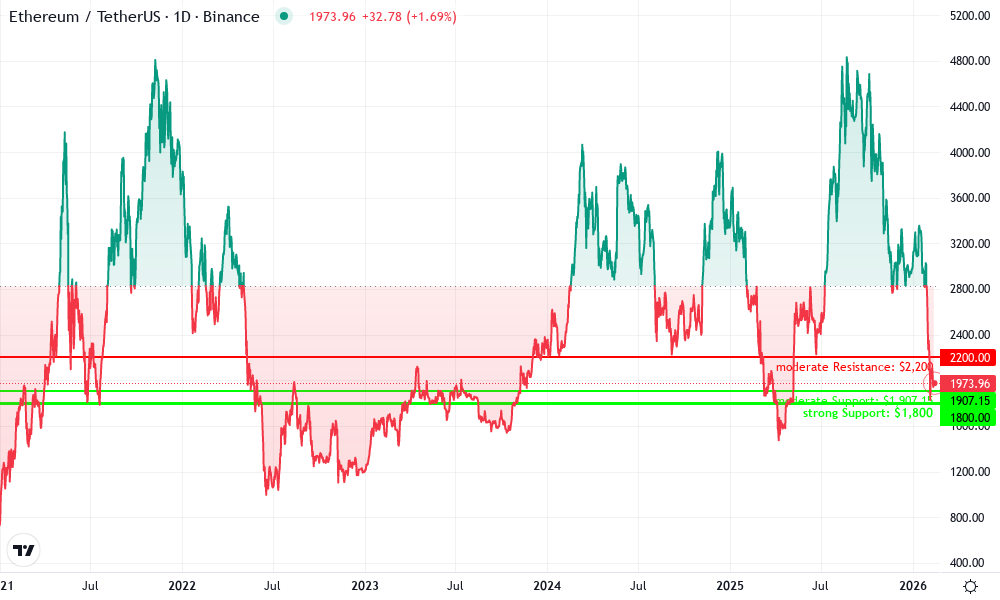
Analysis by Isabel Finch | Symbol: BINANCE:ETHUSDT | Interval: 1D | Drawings: 6
Technical Analysis Summary
To annotate this ETHUSDT chart in my conservative style, start by drawing horizontal_lines at key support (1,907.15) and resistance (2,001.87) levels reflecting the 24h range. Add trend_line for the recent downtrend from mid-June 2026 high near 2,200 to current levels around 1,967. Use rectangle for the ongoing consolidation zone from early July 2026 between 1,900-2,000. Mark volume spikes with arrow_mark_down on declining bars. Place callout on MACD for bearish divergence. Add text boxes for fundamental notes on ReyaChain's Q1 2026 rollout supporting long-term ETH value. Use fib_retracement from recent swing high to low for potential retracement levels. Finally, horizontal_line for entry zone at 1,950 with low-risk label.
Risk Assessment: medium
Analysis: Technicals show consolidation with bearish indicator bias, but fundamentals via ReyaChain provide long-term tailwind. Low volume mitigates immediate crash risk, yet volatility persists.
Isabel Finch's Recommendation: Hold or enter low-risk longs at support; prioritize research on ETH L2 adoption over technical breakouts. Research first, profits follow.
Key Support & Resistance Levels
📈 Support Levels:
- $1,907.15 - 24h low and psychological support near recent lows, aligns with 0.618 fib retracement moderate
- $1,800 - Prior consolidation base from early 2026, volume cluster strong
📉 Resistance Levels:
- $2,001.87 - 24h high, immediate overhead resistance weak
- $2,200 - Swing high from June 2026, fib 50% retracement moderate
Trading Zones (low risk tolerance)
🎯 Entry Zones:
- $1,950 - Bounce from support zone with volume confirmation, low-risk long aligned to Reya fundamentals low risk
- $1,907 - Strong support test for dip-buy, but only on bullish MACD flip medium risk
🚪 Exit Zones:
- $2,100 - Profit target at resistance confluence 💰 profit target
- $1,850 - Stop loss below key support to limit downside 🛡️ stop loss
Technical Indicators Analysis
📊 Volume Analysis:
Pattern: declining on advances, spiking on declines
Bearish divergence; low volume rallies suggest lack of conviction, distribution likely
📈 MACD Analysis:
Signal: bearish crossover
MACD line below signal with histogram contracting negatively, confirming short-term weakness
Applied TradingView Drawing Utilities
This chart analysis utilizes the following professional drawing tools:
Disclaimer: This technical analysis by Isabel Finch is for educational purposes only and should not be considered as financial advice. Trading involves risk, and you should always do your own research before making investment decisions. Past performance does not guarantee future results. The analysis reflects the author's personal methodology and risk tolerance (low).
Looking ahead, ReyaChain's 2026 roadmap promises an order book launch in Q1, full based migration with a single execution node in Q2, and rotating nodes in Q3. This evolution underscores a key truth: trading demands infrastructure that scales with ambition.
Based Rollups: The 2026 Standard for Trading DEX Launches
Why base your trading rollup on Ethereum's sequencer? Decentralization is the answer. Traditional rollups often centralize sequencing, inviting censorship risks. Based rollups like ReyaChain leverage Ethereum's validators directly, inheriting their robustness. In 2026, as L2s and L3s proliferate, this model dominates rollup as a service 2026 discussions, blending speed with trustlessness.
Consider the benefits: sub-ms latency rivals centralized exchanges, yet proofs settle on Ethereum for finality. ReyaChain's AnyTrust data availability optimizes costs, focusing calldata on executions while orders stay off-chain until needed. For serious traders, this means zero-fee perps with concentrated liquidity, powering internet capital markets that unify DeFi, TradFi, and CeFi.
Ethereum (ETH) Price Prediction 2027-2032
Forecasts driven by rollup adoption like ReyaChain, enhancing trading speeds, volumes, and Ethereum's L2 ecosystem
| Year | Minimum Price | Average Price | Maximum Price | YoY Growth % (Avg from Prev) |
|---|---|---|---|---|
| 2027 | $3,000 | $4,500 | $6,500 | +129% (from 2026 $1,967) |
| 2028 | $4,200 | $6,500 | $9,500 | +44% |
| 2029 | $5,500 | $8,500 | $12,500 | +31% |
| 2030 | $7,000 | $11,000 | $16,000 | +29% |
| 2031 | $9,000 | $14,000 | $20,000 | +27% |
| 2032 | $11,500 | $18,000 | $26,000 | +29% |
Price Prediction Summary
Ethereum prices are expected to surge from 2027-2032 due to trading-specific rollups like ReyaChain driving massive L2 adoption, sub-ms execution, and TVL growth. Average price projected to climb from $4,500 to $18,000, with peaks potentially exceeding $26,000 in bullish cycles fueled by institutional inflows and scalability upgrades.
Key Factors Affecting Ethereum Price
- Rapid adoption of based rollups (e.g., ReyaChain) increasing ETH transaction volumes and fees
- Ethereum L2 ecosystem maturity with gasless, high-speed trading
- Market cycles aligned with Bitcoin halvings and bull runs
- Regulatory progress enabling institutional ETH ETFs and custody
- Technological advancements in ZK proofs and data availability
- Competition dynamics favoring Ethereum's dominance and network effects
- Macro factors: lower interest rates, global economic recovery, and crypto market cap expansion to $10T+
Disclaimer: Cryptocurrency price predictions are speculative and based on current market analysis. Actual prices may vary significantly due to market volatility, regulatory changes, and other factors. Always do your own research before making investment decisions.
Market data reinforces the momentum. Ethereum's steady $1,967.14 price, with minimal 24-hour fluctuation, signals maturity. Projects mimicking ReyaChain will capture slices of this expanding pie, but only if deployment is frictionless.
Streamline ReyaChain Rollup Deployment with RaaS
Enter Rollup-As-A-Service, the platform that abstracts away the complexities of ReyaChain rollup deployment and trading DEX rollup launch. No need to fork Arbitrum Orbit from scratch or wrestle with sequencer delegation. RaaS provides pre-configured stacks for trading-specific rollups, complete with node specialization templates, dual execution setups, and based sequencing integrations.
Startups and enterprises can customize liquidity models, embed maker-taker economics, and launch gasless interfaces in weeks, not months. Our service boasts industry-leading uptime, robust documentation, and expert support tailored for blockchain deployments. Measure the risks twice, as I always say, then deploy once: RaaS handles the infrastructure so you innovate on trading mechanics.
By Q1 2026, when ReyaChain rolls out its order book, competitors using RaaS will be right behind, vying for that $32 billion volume milestone. Ethereum at $1,967.14 today underscores the timeliness; scalability solutions like these fuel the next leg up.
Risk assessment reveals why RaaS shines for custom app-chain rollups. Traditional deployments expose teams to sequencer centralization risks, data availability bottlenecks, and execution latency spikes. ReyaChain mitigates these through delegation and specialization, but replicating that demands expertise. RaaS quantifies these variables upfront, offering stress-tested configurations that withstand volatility like Ethereum's recent swing from $1,907.15 to $2,001.87.
ReyaChain's Roadmap: Milestones Shaping 2026 Trading
ReyaChain's trajectory provides a blueprint for aspirants. From its Arbitrum Orbit fork to full based maturity, each phase builds toward unified capital markets. Traders benefit from progressive enhancements in speed and decentralization, with cumulative volume already at $32 billion signaling real traction.
These steps highlight a measured evolution, prioritizing verifiability over haste. In my experience analyzing DeFi risks, such phased rollouts minimize exposure to untested code, ensuring Ethereum's $1,967.14 stability translates to chain uptime.
Deploy Your Trading Rollup: Mirror ReyaChain with RaaS in 5 Steps



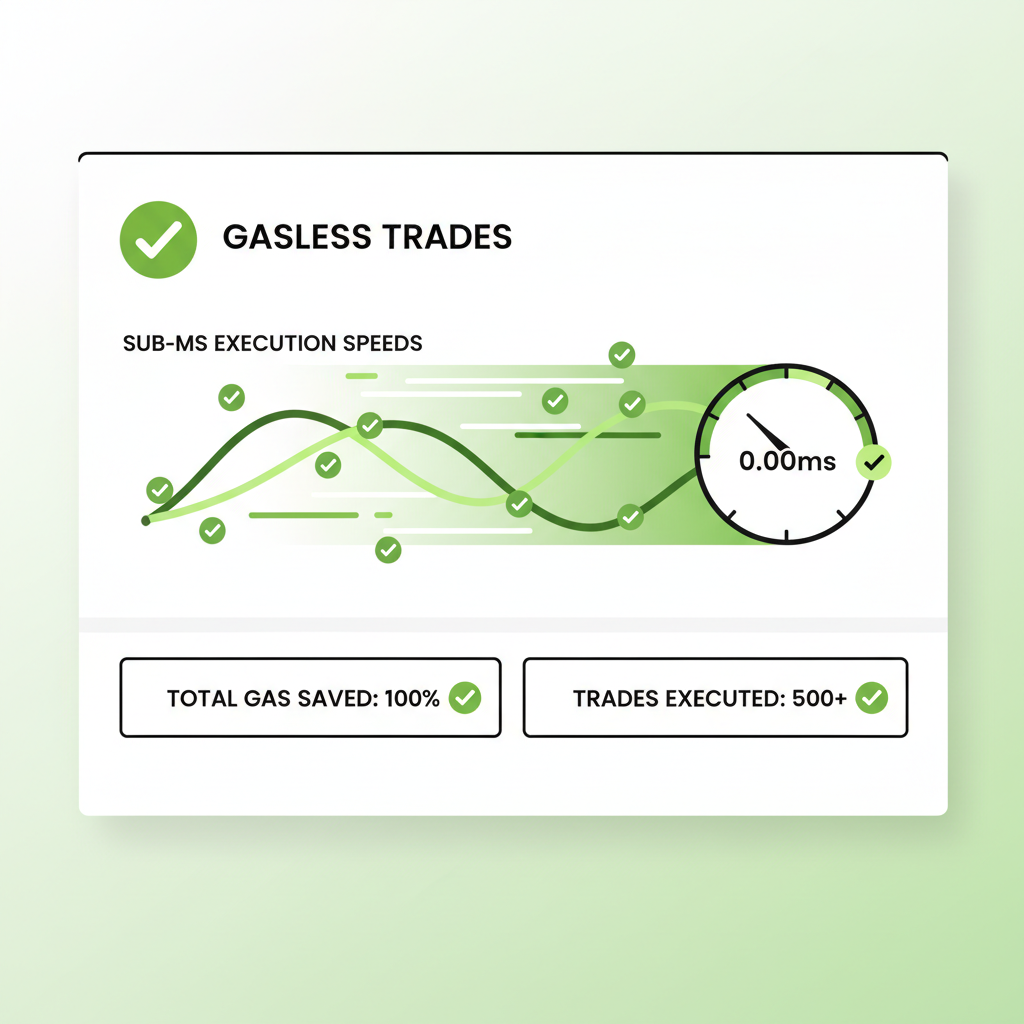

This process embodies my philosophy: measure risks twice, deploy once. Volatility tests like Ethereum's and $1.78 24-hour gain prove resilient infrastructure wins.

Deeper integration awaits in 2026. RaaS supports L3 extensions atop based rollups, stacking for ultra-low latency. Imagine order books rivaling Nasdaq, settled on Ethereum at $1,967.14, drawing institutional flows. ReyaChain's $13.7 million open interest hints at the prize; RaaS positions you to claim it.
For enterprises eyeing based rollups for trading, the calculus favors action now. Centralized exchanges falter under scrutiny, while verifiable chains like these endure. RaaS delivers the tools, documentation, and uptime to outpace peers, turning Ethereum's steady price into your growth catalyst. Builders ready to redefine trading infrastructure find here the scalable foundation for tomorrow's markets.




No comments yet. Be the first to share your thoughts!